

Plant-Inspired System Targets Microplastics at Atlantic City Wastewater Plant
A new installation aims to capture plastic particles before treated wastewater reaches the ocean, following laboratory results showing removal rates of around 98%.
Written with AI assistance from the reports named below. How we work
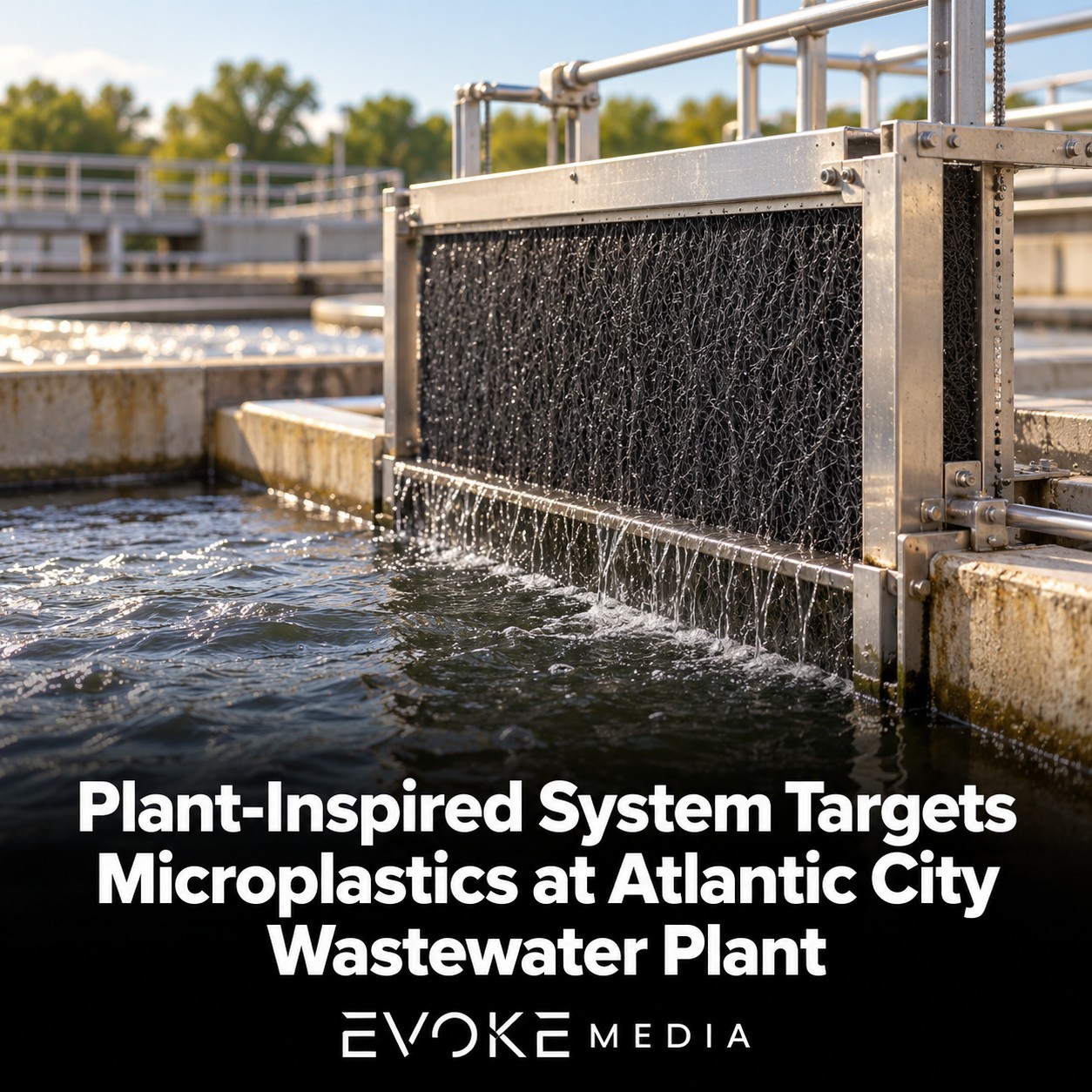
The Atlantic County Utilities Authority has installed technology designed to remove microplastics from wastewater before it enters the Atlantic Ocean, WHYY and Good News Network reported.
Developed by PolyGone, a startup founded by Princeton University graduates Nathanial Banks and Yidian Liu, the system draws on the properties of water-repelling plants. Plastic particles adhere to its filtration material, allowing them to be separated from the water, according to both outlets.
WHYY reported that the installation is fully financed by a federal grant. The utility described it as the first installation of its kind worldwide.
The outlets described the project’s timeline differently. WHYY reported that the system was installed following a two-year pilot programme, while Good News Network described the utility’s involvement as part of a two-year pilot intended to assess large-scale filtration.
Laboratory performance was similar in both accounts, although the figures differed slightly. Good News Network reported that a prototype removed 98% of microplastic particles from wastewater. WHYY reported that the founders put removal above 98% under controlled laboratory conditions.
Those laboratory findings are distinct from commercial-scale performance. Good News Network described reproducing the results at commercial scale as a testing objective. WHYY reported that the founders expected the larger system to capture a majority of microplastics. Their research also found that the technology worked most effectively on smaller particles, according to WHYY.
Banks described the approach as using relatively little material and energy to address contaminants that are difficult to treat, both outlets reported.
Microplastics reach wastewater through several routes. Both outlets identified clothes washing and rain-related runoff as sources. WHYY also described industrial discharges and stormwater carrying particles from vehicle tyres, while Good News Network identified littering.
WHYY explained that plastics fragment into smaller pieces rather than biodegrading, allowing the particles to persist in the environment and accumulate in organisms.
Matt DeNafo, president of the Atlantic County Utilities Authority, told both outlets that removing plastic before discharge was important because untreated particles would otherwise return to the environment. He raised concerns about their presence in fish and water used by people.
Both outlets reported that federal rules do not require utilities to remove microplastics. WHYY additionally reported that there were no state requirements covering their removal from wastewater or drinking water.
WHYY noted that research into the effects on human health remains ongoing and that the specific harms are uncertain.
The founders’ training also influenced the equipment’s appearance. Both outlets described their architecture background, and WHYY reported that Liu credited that experience with shaping the system’s streamlined design.
The work extends beyond New Jersey. Both outlets reported a similar installation in California and said Banks and Liu were interested in adapting the technology for residential use.
At Atlantic City, the stated purpose is to intercept plastic particles within the existing wastewater treatment process, reducing their passage into the ocean, according to WHYY and Good News Network.
Sources
More coverage

Restaurant Conversation Helped a Stranger Return Home, New Hampshire Man Recalls
A conversation at a Chinese restaurant in Dover, New Hampshire, helped a distressed man feel that his life was worth living, according to an account David Couture shared with Good News Network…

St Paul Man Stops Runaway School Bus After Driver’s Medical Emergency
A Minnesota man boarded a moving school bus and pulled its emergency brake after noticing that its driver appeared to be experiencing a medical emergency, The Guardian and Good News Network reported…

Flávio Bolsonaro lands in Miami after defeat in Brazil's presidential election
Bolsonaro's arrival in the US ends speculation about his whereabouts after he failed to comply with an order to surrender his passports.

Flávio Bolsonaro claims to be Brazil’s ‘true president’ after fleeing to Miami
Far-right senator and family land in US after crossing from Brazil into Argentina and then flying via Ecuador Flávio Bolsonaro has declared himself the “true president” of Brazil after losing last Sunday’s presidential election and fleeing to the United States. After landing on a private jet with his family in Miami…