

From Gratitude to School Meals: Evoke Reports Support for 111 Children
Evoke Marketplace says its community has supported 111 children through Akshaya Patra, connecting customer choice and the EVOKE Gratitude Token with a long-running food-for-education programme in India.
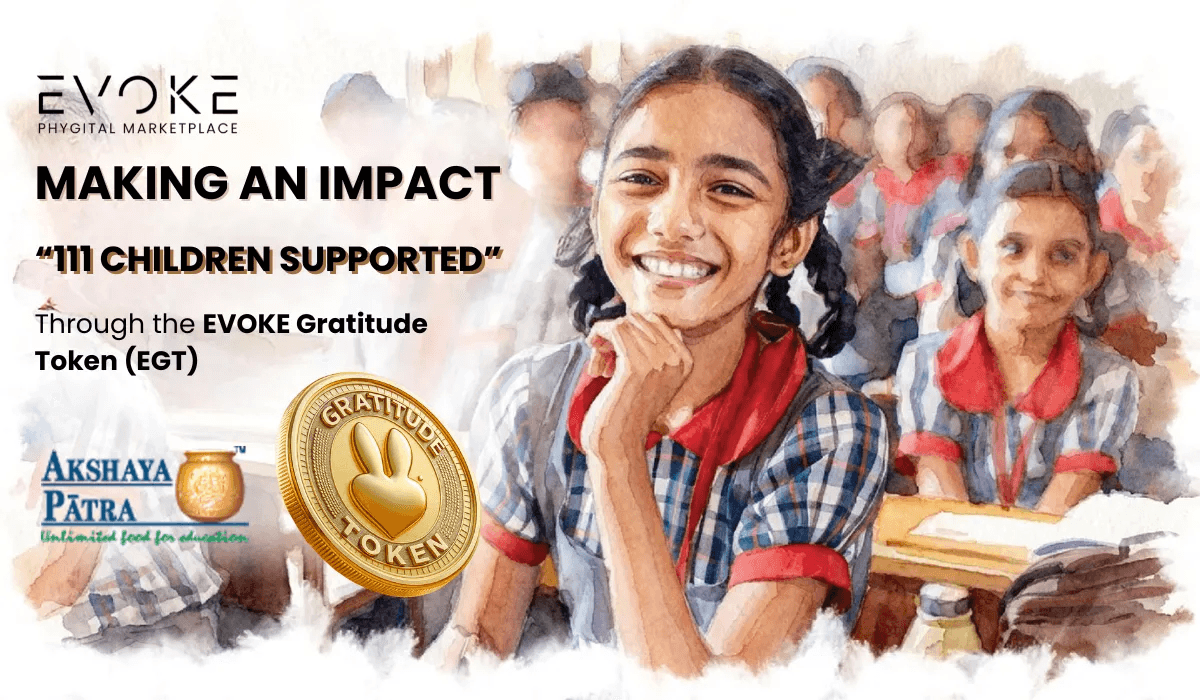
A milestone rooted in purposeful commerce
Evoke Marketplace says its community has supported 111 children through The Akshaya Patra Foundation — a milestone the company connects to purchases made on the platform and to the EVOKE Gratitude Token, or EGT. The figure appears in Evoke Media’s Charity & Impact section, which presents commerce not as the end of a transaction but as a route through which customers and vendors can help direct resources towards social causes.
The reported milestone is modest beside the scale of global need, but that is precisely what makes it concrete. “111 children supported” gives Evoke’s broad language about gratitude and shared responsibility a human unit of measure. It turns an abstract promise of purposeful shopping into a result the company can name and its community can follow.
Evoke says the marketplace launched on November 13, 2025. Since then, it has positioned luxury and lifestyle retail alongside social impact, with vendors from different markets and customers able to select a partner charity to support. The model asks a practical question: if a purchase is going to happen anyway, can the platform also make room for the buyer to express what matters to them?
Why Akshaya Patra’s work matters
Akshaya Patra is an independent charitable trust headquartered in Bengaluru, India. It works with India’s national, state and union-territory governments to implement PM POSHAN, the country’s school meal programme, in government and government-aided schools. Its vision is direct: no child in India should be deprived of education because of hunger.
The foundation began in 2000 by serving 1,500 children in five government schools in Bengaluru. Akshaya Patra now reports that it reaches more than 2.35 million children through 25,768 schools and Anganwadi centres across 78 locations in 16 states and three union territories. Those figures place Evoke’s 111-child milestone inside a much larger public-private system built around nutrition, school participation and educational opportunity.
The programme’s logic is straightforward. A nutritious meal can address immediate hunger while helping a child remain present, attentive and able to participate in school. Akshaya Patra describes its purpose as providing wholesome meals every school day to address classroom hunger and promote education. Its work is therefore not simply food distribution; it is an intervention at the point where nutrition and learning meet.
How the EVOKE Gratitude Token fits the model
EGT is the rewards layer within Evoke’s phygital marketplace. Evoke describes the token as a digital utility token that members can earn through purchases, product reviews, referrals and participation in social-impact activities. Tokens can be used inside the ecosystem for discounts, selected products and experiences, or directed towards supported charities.
That distinction matters. Evoke’s own disclaimer says EGT has no cash value, cannot be exchanged for legal tender and should not be treated as an investment, ownership interest or profit-sharing instrument. Its stated function is community engagement and rewards. In the context of the 111-child milestone, the relevant idea is not speculative value but participation: the token is designed to give members another way to connect ordinary marketplace activity with a chosen cause.
Evoke also says blockchain technology supports the token’s transaction record. The company presents that infrastructure as a means of making exchanges traceable and strengthening trust within the rewards ecosystem. Technology alone does not prove social impact, but it can help organise the record of how tokens are earned, spent and directed when it is paired with clear reporting from the platform and its charity partners.
Choice at checkout
One of the strongest ideas in Evoke’s Charity & Impact model is customer choice. The company says shoppers can select the cause they want to support at checkout, rather than having every transaction flow towards a single platform-selected initiative. That makes the act of giving more personal and gives customers a reason to understand the work of each partner before choosing.
Choice also creates a responsibility to communicate clearly. Customers need to know which organisations are participating, how support reaches them and what terms such as “supported” mean in practice. In this case, Evoke identifies Akshaya Patra and reports the number of children supported, while Akshaya Patra’s own material supplies the wider context for its food-for-education mission.
The model extends to sellers through what Evoke calls its “Purpose Before Profit” initiative. Marketplace vendors are encouraged to align products with commitments spanning education, access to clean water and wellness. The aim is to make social purpose part of a product’s place in the marketplace, rather than an unrelated campaign added after a sale.
From individual actions to a community record
Evoke’s digital Gratitude Circles add a social dimension. The company says members can share impact stories, scores and rewards, allowing participation to be seen and discussed across the community. Done carefully, that can keep attention on outcomes and encourage people to return to the causes behind the transactions.
There is a useful balance to preserve. Recognition can motivate participation, but the people and communities receiving support should remain at the centre of the story. The attached campaign artwork does this by focusing on schoolchildren and Akshaya Patra’s “food for education” mission, while the Gratitude Token appears as the mechanism supporting the initiative rather than as the beneficiary.
A credible impact community also depends on evidence that can be revisited. Named partners, dated milestones and clearly defined measures make progress easier to understand over time. They allow customers, vendors and readers to distinguish an aspiration from a reported result and to see whether the programme is growing.
What the public record establishes
Evoke Media’s public Charity & Impact section reports that 111 children have been supported through Akshaya Patra and connects that outcome to marketplace transactions and EGT. Evoke’s marketplace documentation explains how members earn and use the utility token, including the option to direct tokens towards supported charities. Akshaya Patra’s official materials establish the foundation’s mission, operating model and national scale.
The public impact section does not specify a monetary total, a number of meals, a geographic allocation or the period over which the 111 children were supported. It also does not define whether “supported” represents an academic-year sponsorship or another contribution measure. For that reason, this article does not convert Evoke’s milestone into money, meals or a duration that the published sources do not provide.
That boundary is important in impact reporting. It does not diminish the milestone; it states it accurately. Evoke has put a specific figure and a named partner into the public record. Future updates can strengthen that record further by adding dates, contribution definitions and partner confirmation alongside each new total.
A practical expression of gratitude
The 111-child milestone offers an early measure of what Evoke means by a gratitude economy. Customers make choices, vendors attach commitments to products, EGT records participation inside the marketplace, and a specialist nonprofit delivers work on the ground. Each participant has a different role, but the intended outcome is shared.
For Akshaya Patra, outside support contributes to a programme built around a simple connection: children are better placed to learn when hunger is not standing between them and the classroom. For Evoke, the partnership gives its purpose-led marketplace a concrete channel through which community activity can reach an established organisation.
The significance of the number is therefore both immediate and forward-looking. It represents 111 children in Evoke’s current reporting, but it also creates a baseline against which the marketplace can measure what comes next. If future reporting remains specific, attributable and transparent, the community will be able to see how gratitude moves from an idea to a sustained form of support.
More coverage

Healey appoints Labour manifesto writer, fuelling election speculation
Exclusive: Economist Ravinder Athwal who worked in Keir Starmer’s team is poached from Flint Global Business live – latest updates Ravinder Athwal, the economist who wrote Labour’s 2024 manifesto, is taking on a senior role as an adviser to John Healey, in a move likely to fuel speculation about an early general…

People in the Shetlands or the Outer Hebrides: how are you coping with the diesel prices?
Are you taking fewer journeys by car? Or are you cutting back in other areas to pay your diesel bill? Russia’s war-damaged refineries and the Middle East crisis have erased about a fifth of the world’s diesel supplies and are pushing up the price of diesel at forecourt pumps. We would like to speak to people living in…

Britain’s low-paid urged to sign up to savings scheme offering cash bonus
Government-backed help to save is aimed at working people on universal credit and pays 50p for every £1 saved over four years Amid claims that millions are missing out, the UK government is encouraging low earners to sign up to a savings scheme that offers free cash. Help to save is a government-backed savings account…
Why this Pokémon set is dropping in value
How does one price a cemetery plot? Are they using dynamic pricing to figure it out? We tackle that question and many more in this week's Indicator newsletter.