

Boston Dynamics Redesigns Atlas Hand for Tool Use and Mass Production
Atlas’s new four-fingered hand combines greater movement with a design focused on reliability, repairability and learning through simulation.
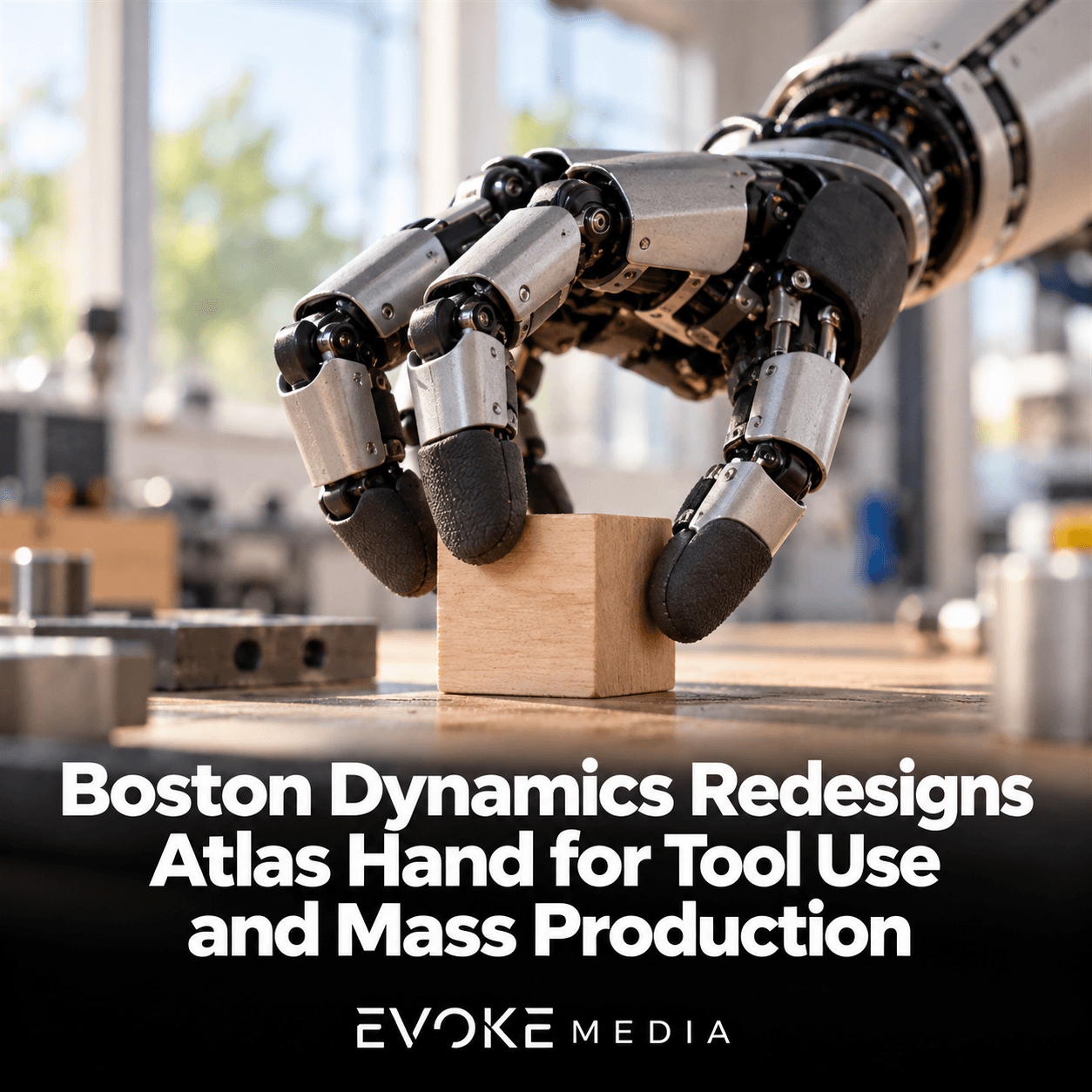
Boston Dynamics unveiled a redesigned hand for its Atlas humanoid robot on October 1, 2026, replacing its previous three-fingered design with four fingers and increasing its degrees of freedom from seven to 13. IEEE Spectrum and The Robot Report both reported that the redesign prioritizes practical manipulation, reliability and mass manufacturing over closely reproducing the appearance of a human hand.
According to IEEE Spectrum, the earlier hand was research hardware that had not been intended for production in quantities reaching tens or hundreds of thousands. The Robot Report described a corresponding change in purpose: previous versions emphasized grasping many kinds of objects, while the new hand focuses more on manipulating them after they have been grasped.
Both outlets reported that Boston Dynamics decided against adding a pinky after team members spent a day with their pinky and ring fingers taped together. The Robot Report identified chief product and technology officer Zachary Jackowski as the person who requested the experiment. It also reported mechanical engineer Dylan Thrush’s explanation that the additional capabilities did not justify three more degrees of freedom, greater complexity, increased size and power consumption.
The additional movement is not simply the result of adding another finger. IEEE Spectrum reported that the redesign allows fingers to spread apart, supporting movement between fingers and grips on tools with triggers. The Robot Report listed capabilities including pinching between the thumb and any other finger, three-finger grasps, repositioning objects within the hand and recovering when an object starts slipping. Its examples of usable tools included drills, grinders, nail guns and welding torches.
Both reports described actuators located directly at the joints, with transmissions that can be driven backward by external forces. Neither design requires fragile cables crossing the joints. IEEE Spectrum reported that each actuator assembly can be replaced as a unit, while The Robot Report added that the joints use a single actuator type and that the actuators are fully enclosed.
The Robot Report provided further details about sensing and dimensions that were not included in IEEE Spectrum’s account. It reported that dense pressure sensors cover the fingertips and palm, supplementing information about the robot’s own movement. The hand is approximately the size of a large human hand, and Boston Dynamics said it retained strength similar to that of the previous version.
Simulation is another shared emphasis. IEEE Spectrum reported that the hand was designed to be simulated accurately and to remain sufficiently similar to a human hand for human demonstrations to support training. The Robot Report explained that Boston Dynamics considers demonstrations useful for capturing visual complexity but insufficient for reproducing the rapid feedback and force regulation needed for dexterous manipulation.
According to The Robot Report, Boston Dynamics designed the hand to support reinforcement learning in simulation, including training under varied friction, object shapes, motor behavior and disturbances. The company reported promising initial transfers of simulated behavior to hardware.
The outlets supplied different details about preparations for deployment. IEEE Spectrum reported that Alberto Rodriguez, Boston Dynamics’ director of robot behavior, said the team was examining design changes needed to manufacture 100,000 hands annually. Separately, The Robot Report said the announcement followed the opening of a Georgia training facility for integrating Atlas into parent company Hyundai’s automotive manufacturing operations.
Sources
More coverage

‘These guys are just coming from nothing’: questions over multibillion-dollar Firmus float amid datacentre backlash
‘AI factories’ developer on track to launch the second-biggest IPO in Australian history, but investors warn its forecasts are ‘a little bit of a fairytale’ Get our breaking news email , free app or daily news podcast From her balcony in Launceston, Kayla Thompson can see the buzz of construction at what will soon be…
Calling robotics startups: Submissions for the 2026 Robotics Startup Radar close soon
Submit now to be part of the Robotics Startup Radar, which brings together some of the most promising robotics startups. The post Calling robotics startups: Submissions for the 2026 Robotics Startup Radar close soon appeared first on The Robot Report .

OpenAI disclose another hack on government department in Australia
Attack accessing historical data on bushfires occurred in June but not disclosed by the tech company until Thursday Get our breaking news email , free app or daily news podcast Artificial intelligence company OpenAI has disclosed another unauthorised hack on a government department in Australia. In June, an OpenAI…

‘It could get an orgasm out of a cabbage’: the best vibrators, tested
From bullets to rabbits to wand vibrators, our sexual wellbeing expert demystifies what’s available and rates her top 17 models (she tested 67) • 26 easy ways to spice up your sex life I could write here about how almost a fifth of women surveyed by Durex said using a sex toy was the most dependable way for them to…