

Acrylic Recycling Method Recovers Up to 98% as Reusable Building Blocks
ETH Zurich researchers have developed a solvent-free process that recovers pure material from acrylic glass at lower temperatures than previous methods.
Written with AI assistance from the reports named below. How we work
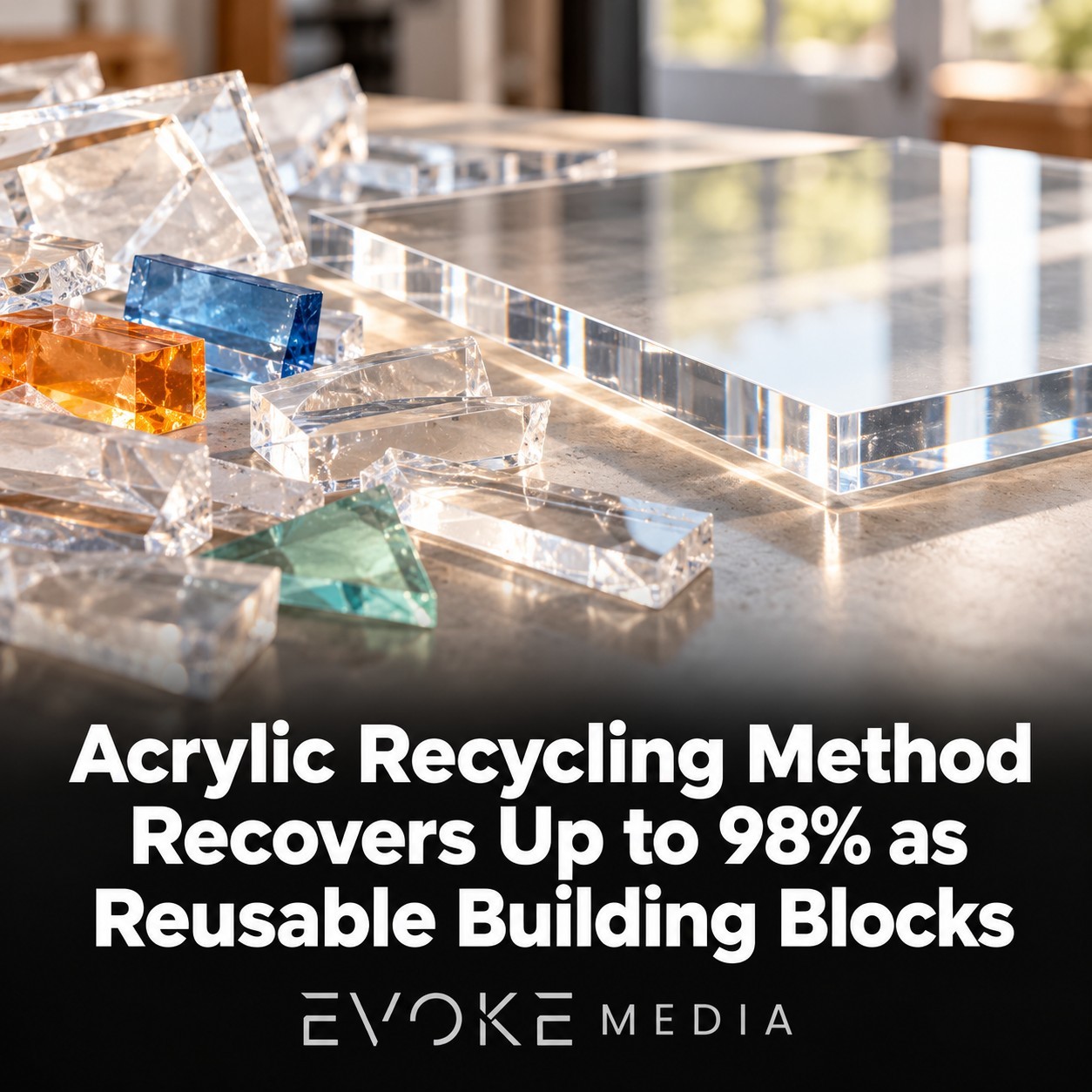
Researchers at ETH Zurich have developed a method for breaking acrylic glass down almost entirely into its original building blocks, according to Good News Network and ETH Zurich.
Both described the approach as a practical route to high-quality recycling of a material used in windows, car taillights, furniture and protective barriers.
ETH Zurich reported that the process uses one inexpensive, commercially available chemical and recovers up to 98% of the acrylic as pure monomers. The reaction begins just above 200°C, approximately half the temperature required by previous methods, and requires no solvents.
According to ETH Zurich, the recovered material remained sufficiently pure to manufacture products matching the quality of virgin plastic, even when the original acrylic contained dyes or impurities.
ETH Zurich also reported that the method works with existing equipment and standard processes, avoiding the need for expensive industrial overhauls. It attributed acrylic’s previous disposal as waste largely to recycling methods that were costly, energy-intensive or difficult to adopt.
The institution has filed a patent and is seeking industry partners to scale up the process. ETH Zurich identified Richard Whitfield as lead author of the study, published in Nature Chemistry.
Sources
More coverage
Healthy Coral Clones Help Bleached Fragments Recover in Laboratory Study
Bleached coral fragments recovered after contact with healthy, genetically identical neighbours in a laboratory study, according to Stanford and The Optimist Daily. The researchers observed…

Waste-Derived Gas Offers Businesses a Fuel Option Compatible With Existing Equipment
Methane captured from agricultural waste, landfills and wastewater treatment can be processed into renewable natural gas for commercial use, offering businesses an alternative to fossil-derived fuel…

Physicists sank a telescope 1.5 miles under the sea to put Einstein's relativity to the test
A half-built neutrino telescope on the floor of the Mediterranean Sea searched for cracks in one of physics' most basic invariances. It came up empty, but its limits rival those of detectors many times its size.
Selective hunting may be making Madagascar’s largest bats smaller, study says
Madagascar’s largest fruit bat is getting smaller, and hunting may be partly to blame, a recent study suggests. The Malagasy flying fox (Pteropus rufus) feeds mainly on fruit and nectar, making it an important pollinator and seed disperser. But the species is also hunted for meat, both for subsistence and commercial…