

Community Rice Plots Help Indian Farmers Preserve More Than 1,000 Indigenous Varieties
The Better India reported that Usha Soolapani’s conservation work connects more than 30,000 farmers across six states through seed banks, shared knowledge and traditional rice cultivation.
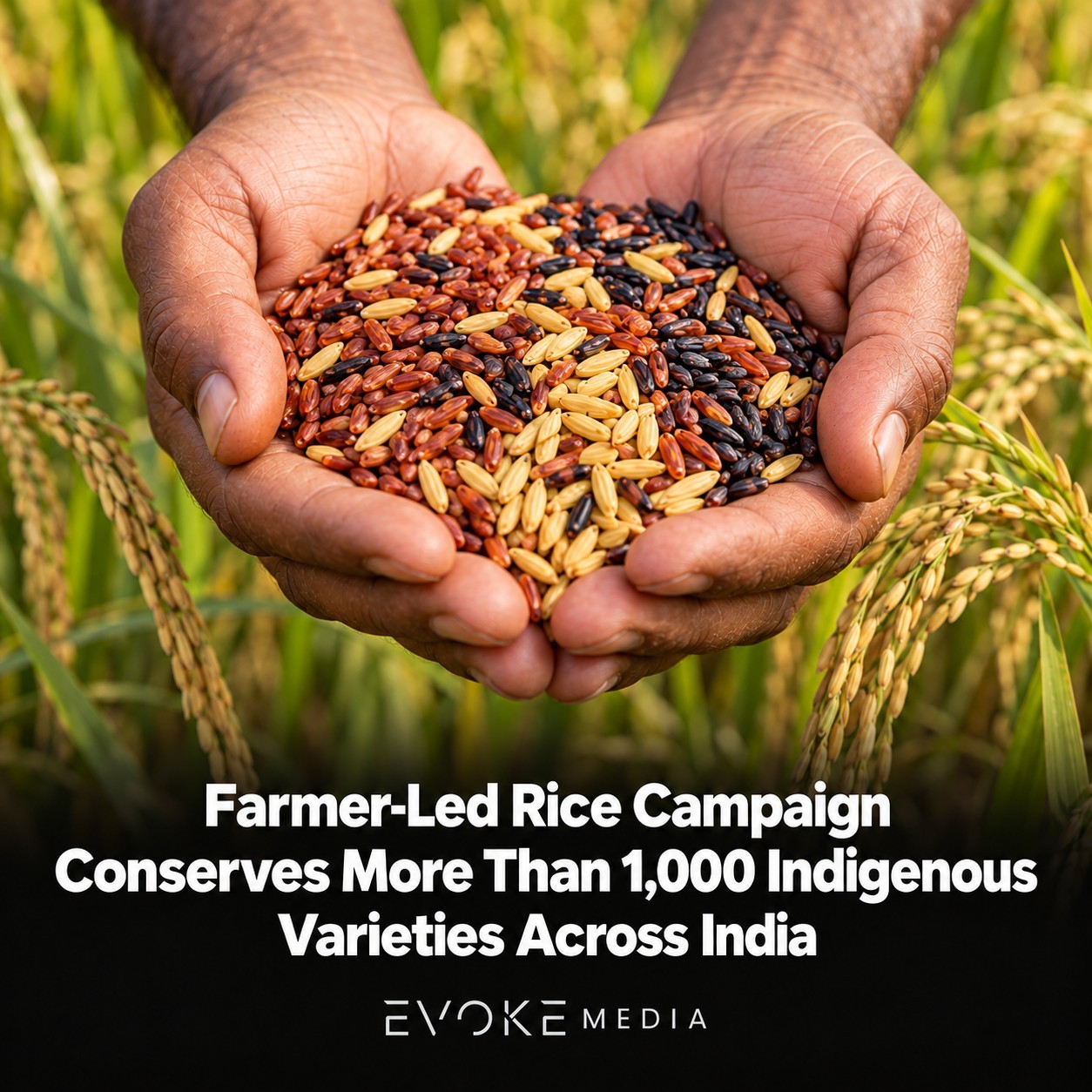
More than 30,000 farmers across six Indian states are conserving over 1,000 indigenous rice varieties through community-managed growing plots, according to The Better India. The work forms part of the Save Our Rice Campaign, which brings together farmers, seed savers and environmental organisations.
The outlet described how Usha Soolapani helped develop the movement through her work with Thanal, an environmental organisation in Kerala. Its approach combines seed conservation with ecological farming, food traditions and community control over planting material.
Usha’s interest in chemical-free agriculture was shaped by Masanobu Fukuoka’s book, The One-Straw Revolution, The Better India reported. Working as an agriculture officer in Palakkad, she witnessed farmers facing rising costs and stagnant grain prices while development displaced wetlands and paddy fields.
According to the outlet, her campaigning against Endosulfan strengthened her concern about the links between agricultural practices, public health and environmental protection.
Between 2005 and 2018, Usha and her Thanal colleagues travelled through rice-growing regions to find farmers still preserving ancestral seeds. Some kept planting material in clay pots or kitchen rafters. In other cases, varieties survived with only one or two farmers cultivating small patches.
The Better India reported that the campaign helped identify, document and circulate these seeds. Varieties being grown again include Mappilai Samba from Tamil Nadu, Raktha Sali from Kerala and Rajamudi from Karnataka.
The regional Save Our Rice Campaign was launched by Pesticide Action Network Asia Pacific in 2003, according to the outlet. Thanal became a key participating organisation in India, where the campaign works through local partners rather than imposing a uniform farming model.
Its Rice Diversity Blocks allow communities to grow, multiply and conserve traditional varieties. Farmer-managed seed banks at the panchayat level complement these plots, keeping seeds available for cultivation and exchange.
The movement spans Karnataka, Kerala, Tamil Nadu, Chhattisgarh, Jharkhand and West Bengal. The Better India reported that West Bengal coordinator Allauddin Ahmed credited farmers in the Sundarbans with conserving and promoting around 192 folk rice varieties.
Seed fairs also function as places to exchange knowledge. Farmers who initially attended as learners now advise others, while some seed savers have established community banks and farmer-producer companies, according to the outlet.
Related conservation spaces include Syed Ghani Khan’s Rice Diversity Centre in Karnataka’s Mandya district. The Better India reported that it houses more than 1,300 traditional varieties in part of his home. Kerala’s Aluva State Seed Farm also preserves and propagates rare rice displaced by higher-yielding hybrids.
Traditional varieties carry different growing characteristics, flavours and nutritional profiles, the outlet reported. Farmers selected them over generations for conditions including salinity, deep water, drought and pests, alongside local culinary needs.
Usha told The Better India that climate resilience became an increasingly important framework as the movement developed from its original focus on seed sovereignty, rice culture and farmers’ knowledge.
Women’s participation is another priority. According to the outlet, Usha advocates recognising women as agricultural decision-makers and highlights their role in transitions to organic and natural farming.
The campaign has also used food fairs, fellowships, exposure visits, cultural programmes and social media to reach younger people. Outreach in South India has involved food vloggers, organic retailers, film stars, nutritionists and doctors.
The Better India reported that Usha advocates agricultural policies that recognise rice diversity and culture alongside productivity, with farmers taking a stronger role in shaping decisions affecting their fields and livelihoods.
Sources
More coverage

House prices falling in every Australian capital city for first time in 15 years
House prices in Sydney are at a two-year low after falling 4.7% in the September quarter to $1.66m, according to Domain report Get our breaking news email , free app or daily news podcast House prices are falling across every capital city for the first time in 15 years and the second time on record, according to…

Missiles hit Kyiv after Russia agrees to US call to resume Ukraine peace talks
Russia says it is "ready in principle" to resume peace talks and US President Donald Trump says the world is "the closest we've been" to ending the war.

Acrylic Recycling Method Recovers Up to 98% as Reusable Building Blocks
Researchers at ETH Zurich have developed a method for breaking acrylic glass down almost entirely into its original building blocks, according to Good News Network and ETH Zurich. Both described the…

Poll: Voters want Congress to be a check on Trump, trust Democrats more on issues
A new poll shows record support for Democratic congressional candidates ahead of the midterms, as voters feel the party is better attuned to handling their top issues.