

White Dwarf Study Reveals Green Star and Links Unusual Colours to Chemistry
Live Science and Space.com reported that researchers identified a green white dwarf and a potentially record-red counterpart by modelling how their light would appear to human eyes.
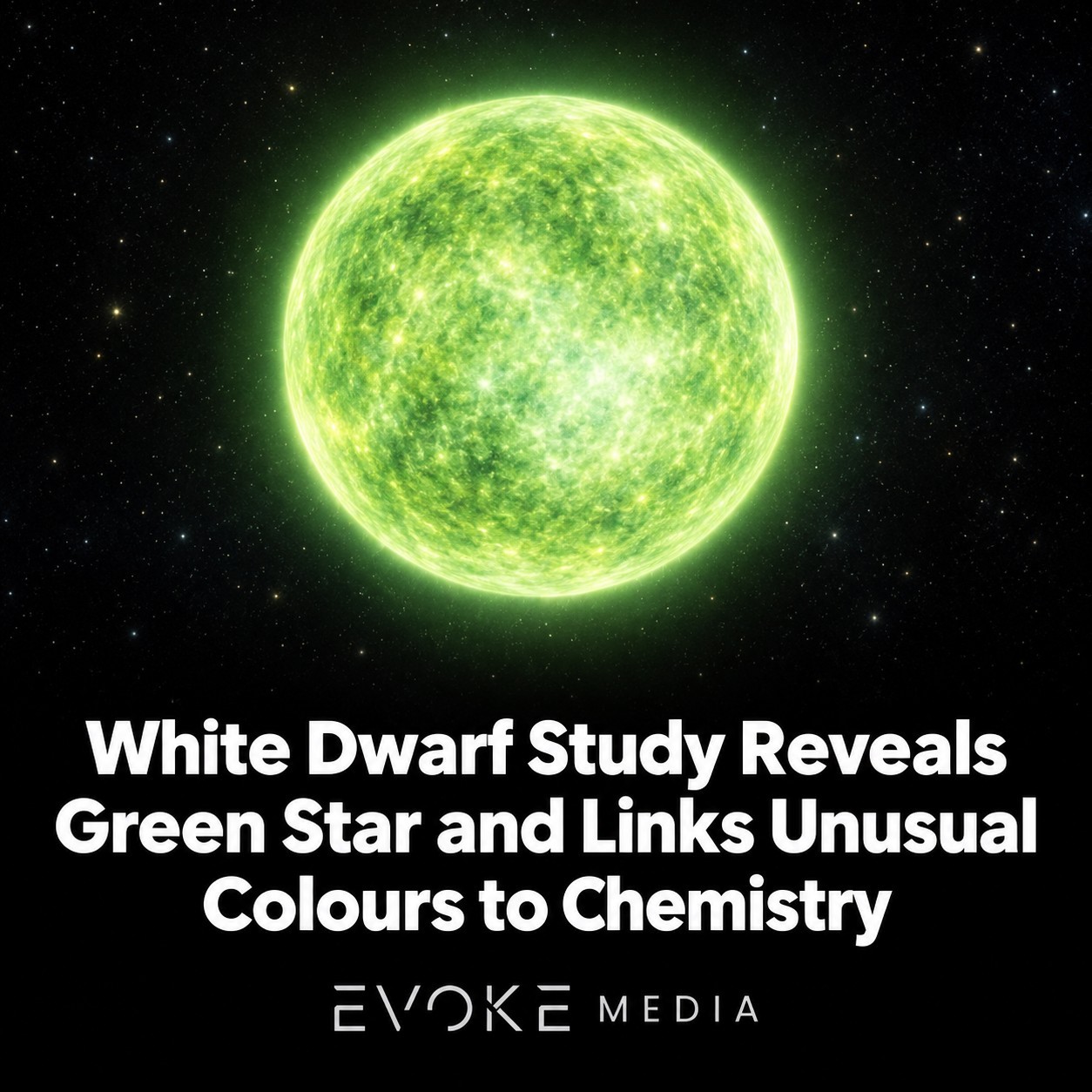
White dwarfs can appear green, pink, purple, cyan and yellow, rather than only the colours suggested by their name, according to research covered by Live Science and Space.com. The findings link these unusual appearances to the chemistry of the dense stellar remnants’ atmospheres.
Both outlets reported that researchers identified WD J1330+6435 as the first known genuinely green star. They also described another white dwarf, WD J1011+2845, as potentially the reddest star yet found.
White dwarfs are the dense, cooling cores left when low- to medium-mass stars exhaust their fuel, Live Science explained. Both outlets reported that their name reflects the white or pale-blue appearance of the first examples discovered.
For most stars, temperature largely determines colour: cooler stars appear orange, while hotter ones look white or pale blue, according to Space.com. The research, led by University of Warwick astronomer Mark Hollands, examined how white dwarfs can depart from that pattern.
Live Science reported that the stars’ small size and distance make their colours difficult to verify directly. Researchers instead analysed their spectra—the distinctive patterns in their light—and used a model of human colour vision to establish how they would appear.
Both outlets attributed the unusual colours to conditions in white dwarf atmospheres. Live Science described cooler white dwarfs’ atmospheric densities as comparable to water and millions of times greater than the sun’s visible surface. In dense helium plasma, elements including carbon, calcium and sodium absorb light across broader ranges than they would under less dense conditions.
That absorption changes the light remaining visible. Both outlets reported that carbon-rich white dwarfs tend towards pink or purple, while material from asteroids and comets can produce yellower colours. Collisions involving hydrogen and helium in dense atmospheres can produce cyan or pale-blue appearances.
For WD J1330+6435, both outlets linked the green colour to an atmosphere containing calcium, lithium and sodium alongside rocky material. Sodium absorbs orange light, changing the balance of colours that escapes.
Space.com added that the star lies around 326 light-years away and has accumulated rocky material from a planetary companion. It reported that the team’s model indicates this atmospheric enrichment gives the white dwarf its green appearance.
The potentially record-red WD J1011+2845 lies roughly 48 light-years from Earth, according to both outlets. Convection carries carbon from its interior towards its surface, where carbon molecules alter its emitted light, producing a deep salmon-pink appearance.
The findings do not mean unusual colours dominate the white dwarf population. Live Science reported that about one in 30 of the 151 white dwarfs studied within 65 light-years of Earth had a colour other than white. Space.com specified that five members of that nearby sample had unusual colouring.
Space.com also reported that University of Warwick physicist Boris Gänsicke said the median colour across a representative white dwarf population remained white, despite the range of individual appearances.
Both outlets identified RAS Techniques and Instruments as the journal publishing the research, but gave different publication dates: Live Science reported October 15, while Space.com reported October 14.
Sources
More coverage
Six Dolphin Births Raise Cambodia’s Irrawaddy Population to Estimated 118
Cambodia’s critically endangered Irrawaddy dolphin population has reached an estimated 118 following the confirmed birth of six calves this year, Mongabay reported. The calves were born along a…

Ancient Alaska Base Camp Reveals Daily Life and Cultural Links Across Beringia
Archaeologists in interior Alaska have uncovered a densely occupied ancient base camp containing stone tools, animal bones and possible dwelling remains, according to Live Science and Gizmodo. The…

Bison Return Supports Conservation Effort in Mexico’s Cuatro Ciénegas
Conservationists in Mexico’s Cuatro Ciénegas valley are combining water protection, native habitat restoration and the return of American bison to support a desert ecosystem under pressure, according…
Examples of Medical Errors That May Lead to a Malpractice Claim
Happy Eco News Examples of Medical Errors That May Lead to a Malpractice Claim Examples of Medical Errors That May Lead to a Malpractice Claim According to a study published in Patient Safety and highlighted by the Agency for Healthcare Research and Quality (AHRQ), diagnostic errors accounted for 26.6% of closed…